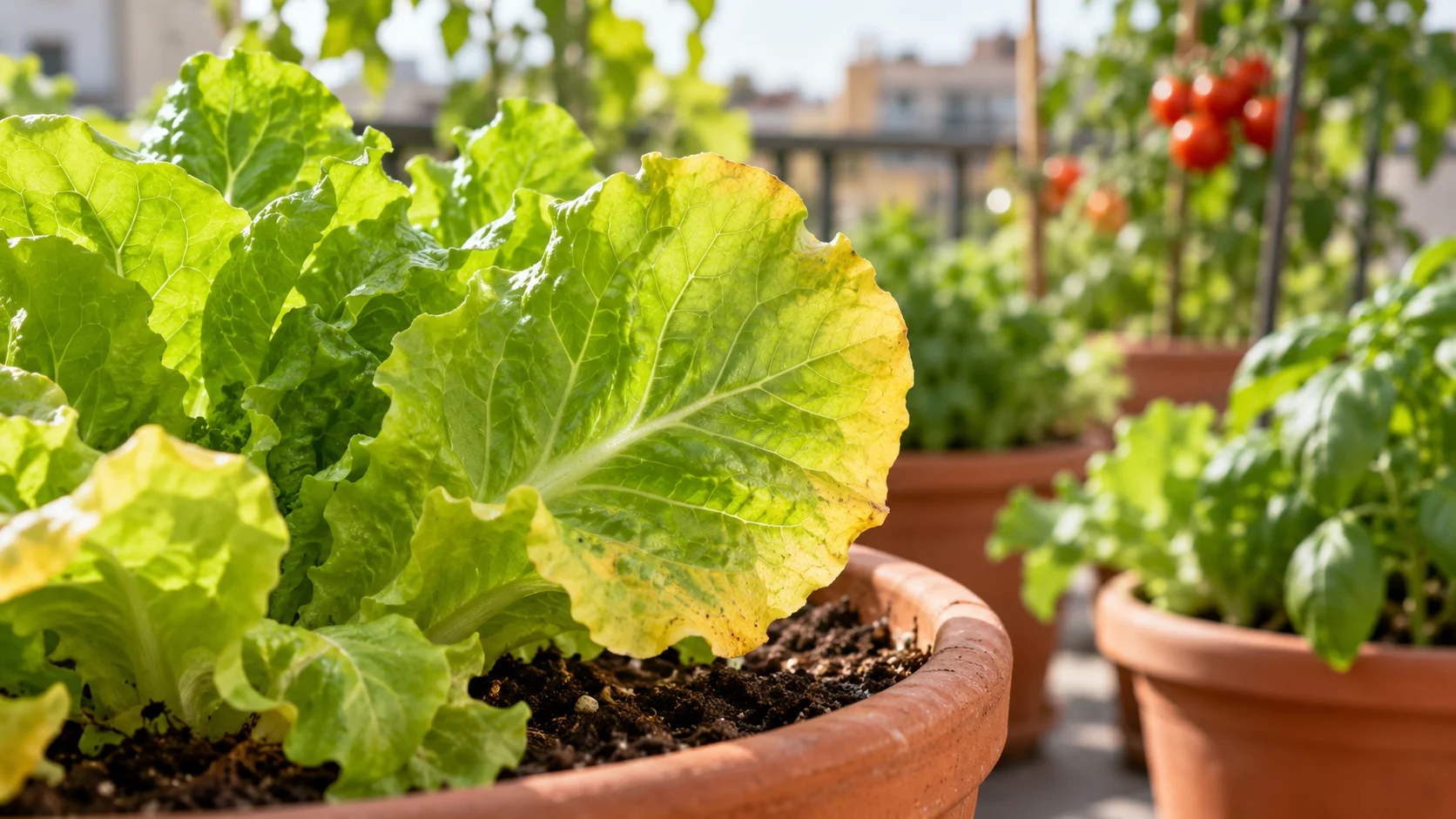

Yellow leaves are the most common signal in the balcony garden. And the most misunderstood: most of the time it is not a disease, it is a message. The classic mistake is rushing for the fungicide, when the plant is actually saying “too much water” or “I am missing nitrogen”.
This guide gets you to the cause in 5 steps, in this order: observe first, act second. If you skip steps 1–3 and go straight to the fertiliser, you risk making things worse.
The golden rule: a uniform, slow yellowing almost always has a nutritional or water cause. Sudden yellowing, in patches or with spots, points to a different problem (pests, disease). In that case go straight to Problems, Pests and Diseases.
Step 1: Where is it yellow?
The where tells you much more than the how much.
- The low, old leaves dry first: nitrogen deficiency, the nutrient the plant moves “from old leaves to new leaves”. It is the most widespread signal in pots.
- The new leaves come out pale, almost whitish: iron deficiency (iron chlorosis). Iron is not mobile in the plant: do the old leaves give it to the new ones? No — the opposite, the new ones stay pale.
- Everything in patches, with brown tips: almost always water, not fertiliser. Go to step 2.
If you stop here you already have 60% of the diagnosis done.
Step 2: The water (cause no. 1 in pots)
The pot has an advantage and a flaw: the advantage is that you control it, the flaw is that there is no margin for error like in the ground.
Two opposite mistakes, same symptom:
- Too much water (the most frequent): the substrate stays sodden, the roots cannot breathe, they rot slowly. The leaves yellow, sometimes with soft tips. Stick in your finger: if at 2–3 cm the substrate has been waterlogged for days, you found the cause. The solution is not “water less”: it is drainage and air (see Watering in containers and Substrate and drainage).
- Chronically dry substrate: rarely the main cause of yellow leaves — more often it produces rolled leaves and dry tips — but in winter, with watering halved, it happens.
Practical test: take the plant out of the pot (or stick a long stick in). White roots = healthy. Brown, soft roots = rot in progress: in this case you act on the drainage and, if it is serious, on repotting.
Step 3: The veins (the iron trick)
Turn the leaf and look at the veins:
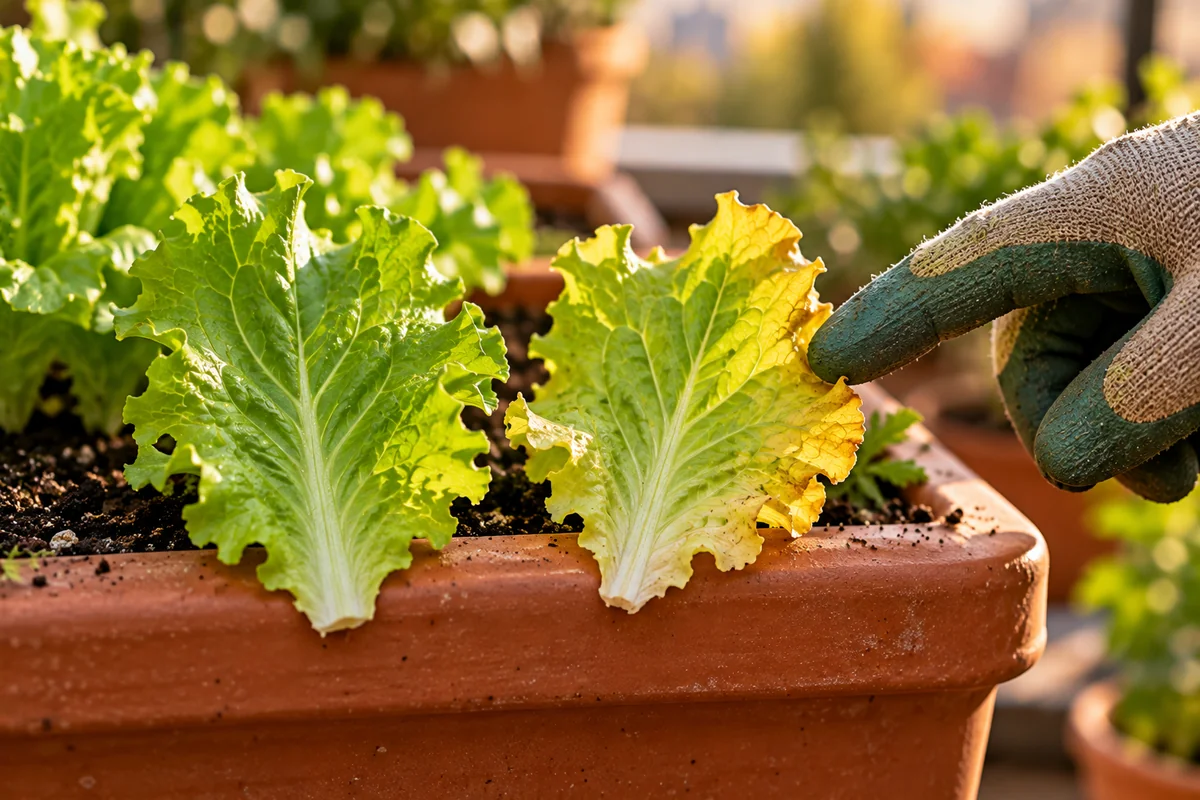
- Yellow with well-green veins = iron chlorosis. The blade is pale, the vein network stays green: a sharp contrast. It happens especially on alkaline substrates (high pH) or chalky ones, where the iron is there but the plant cannot absorb it.
- Uniform yellow, veins included = it is not iron. Back to steps 1–2 or move on to 4.
For iron chlorosis the cure is chelated iron, which stays available at the substrate’s pH: LERAVA chelated iron 200 g dissolves in water and is used both as cure and prevention (1 dose a month in spring–summer). If the substrate is chalky and the problem recurs every year, the real fix is to change the substrate (see Substrate and drainage), not just to supplement.
Step 4: Nitrogen (and how much to feed)
If the old leaves yellow uniformly and the water is regular, you are missing nitrogen: the element that drives growth and green foliage.
The potting rules:
- Leafy vegetables (lettuce, spinach, arugula) are “greedy” for nitrogen: feed every 2–3 weeks, not every month.
- Granular slow-release fertiliser doses itself: a slow-release fertiliser for the garden is sprinkled on the substrate and works for 6–8 weeks.
- In winter (below 8–10 °C) you stop: below that threshold the roots do not absorb, and accumulated fertiliser salinises the substrate.
The full table with doses per crop is in Feeding plants in pots.
Step 5: Salts and substrate
Two “underlying” causes that show up after months:
- Salt build-up: watering only with hard tap water, or overfeeding, leaves white crusts on the surface. The substrate becomes salty and burns the roots. Cure: a generous flush watering (and every spring, changing 30–50% of the substrate).
- Exhausted substrate: after 2–3 seasons in the same pot, the compost compacts and holds neither water nor air anymore. You see it: water runs off the surface without entering. Cure: repot, or at least a surface replacement.
When yellow leaves are a disease
Some patterns are not nutritional:
- Yellow-brown spots that spread quickly, especially after rains or evening sprays: downy mildew (classic on lettuce and courgette).
- Leaves that yellow and drop within hours of being touched: watch for powdery mildew or virus — virus is not curable, the plant is removed.
- Leaflets curling upwards with pale dots: aphids that have been sucking. It is solved with water and Marseille soap (5 ml/l).
The full diagnosis with comparison photos is in Problems, Pests and Diseases.
Table: quick diagnosis
| Where it is yellow | Veins | Probable cause | First cure |
|---|---|---|---|
| Old leaves, uniform | pale | Nitrogen | Feed |
| New leaves, almost white | green | Iron (chlorosis) | Chelated iron |
| Everything, in patches, soft tips | — | Too much water | Drainage |
| Uniform + white crusts | — | Salts in the substrate | Flush + change |
| Fast brown spots | — | Disease (downy mildew) | See disease guide |
Recommended products in this article
| Product | |
|---|---|
| LERAVA chelated iron 200 g | View on Amazon |
| slow-release fertiliser for the garden | View on Amazon |
Sources
- CREA — Fertilising and nutritional deficiencies in vegetable crops (technical sheets)
- Cornell University — Yellow Leaves: causes and corrections (diagnostic guide for water and nutritional causes)
As an Amazon Associate I earn from qualifying purchases. Note: some links on this site are affiliate links: if you purchase through them, I may receive a commission at no extra cost to you. Affiliate links never influence my recommendations.