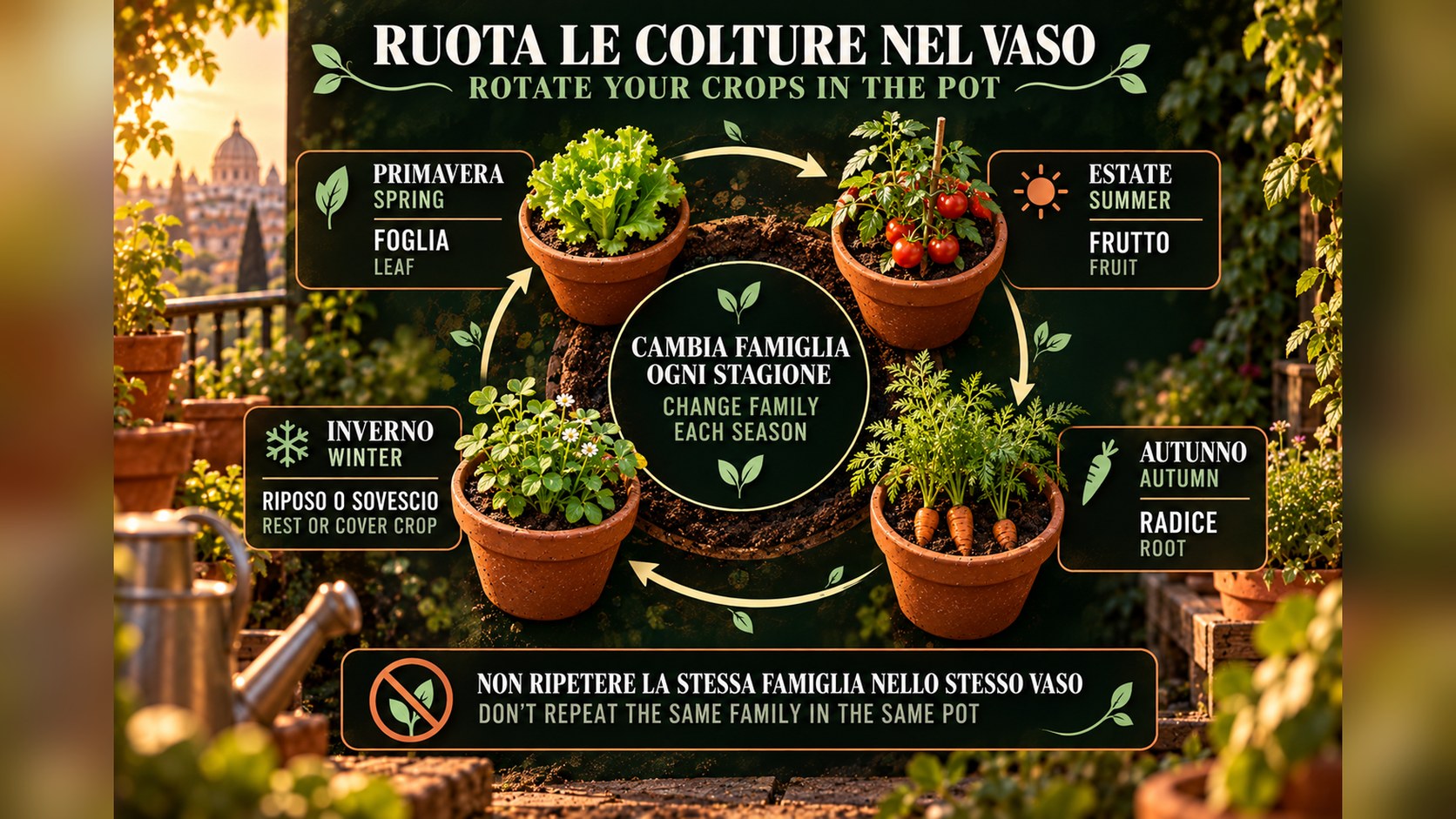

Even in a pot, repeating the same plant in the same substrate year after year concentrates the problems: family-specific pests, selective depletion of nutrients. Rotation and succession in a pot are the answer.
Why rotation and succession works
The pathogens of many diseases stay alive in the substrate for several seasons and mainly attack one plant family: repeating the same crop in the same pot year after year is exactly what they are waiting for. Rotating among families removes their food source and breaks the cycle. There is a second reason: plants draw nutrients in different proportions and with roots of different depths, so alternating families prevents the selective depletion of the same substrate layer.
Rotation and succession: change family
It is the first rule of rotation and succession: don’t repeat the same family in the same pot season after season. The dataset groups the 120 plants into 7 families; rotate among them: where there was a fruiting crop, put a leafy crop or a root crop; where there was a root, a legume (which fixes nitrogen), and so on. In a classic garden a good rotation covers 3–4 years: for solanaceous crops like tomato, avoid repeating them in the same spot for at least 3 seasons. In pots it is simpler than in a bed: each pot is its own little rotation plan.

Succession: don’t leave the pot empty
After harvesting a fast crop (radish, lettuce), immediately sow another crop that finishes before the frost. Succession lengthens the season and reduces the windows in which the substrate is exposed and subject to weeds and waterlogging.
- Fast crops (radish, lettuce, cress): leave room for a second harvest.
- Legumes (bean, pea): leave nitrogen in the substrate for the next crop.
- Staggered succession: for lettuce and radish, sow a little at a time every 2 weeks instead of all at once: the harvest arrives continuously through the season.
The Rotation in containers tool helps you plan rotation and succession per pot, family by family.
Sources
- Royal Botanic Gardens, Kew — Plants of the World Online — taxonomy
- Royal Horticultural Society — plant care
- University of Maryland Extension — container growing
- University of Minnesota Extension — containers and climate
- Penn State Extension — urban container growing
- UMN — Gardening in Small Spaces — rotation in small spaces
- UMN — Preventing Plant Diseases in the Garden — rotation and disease