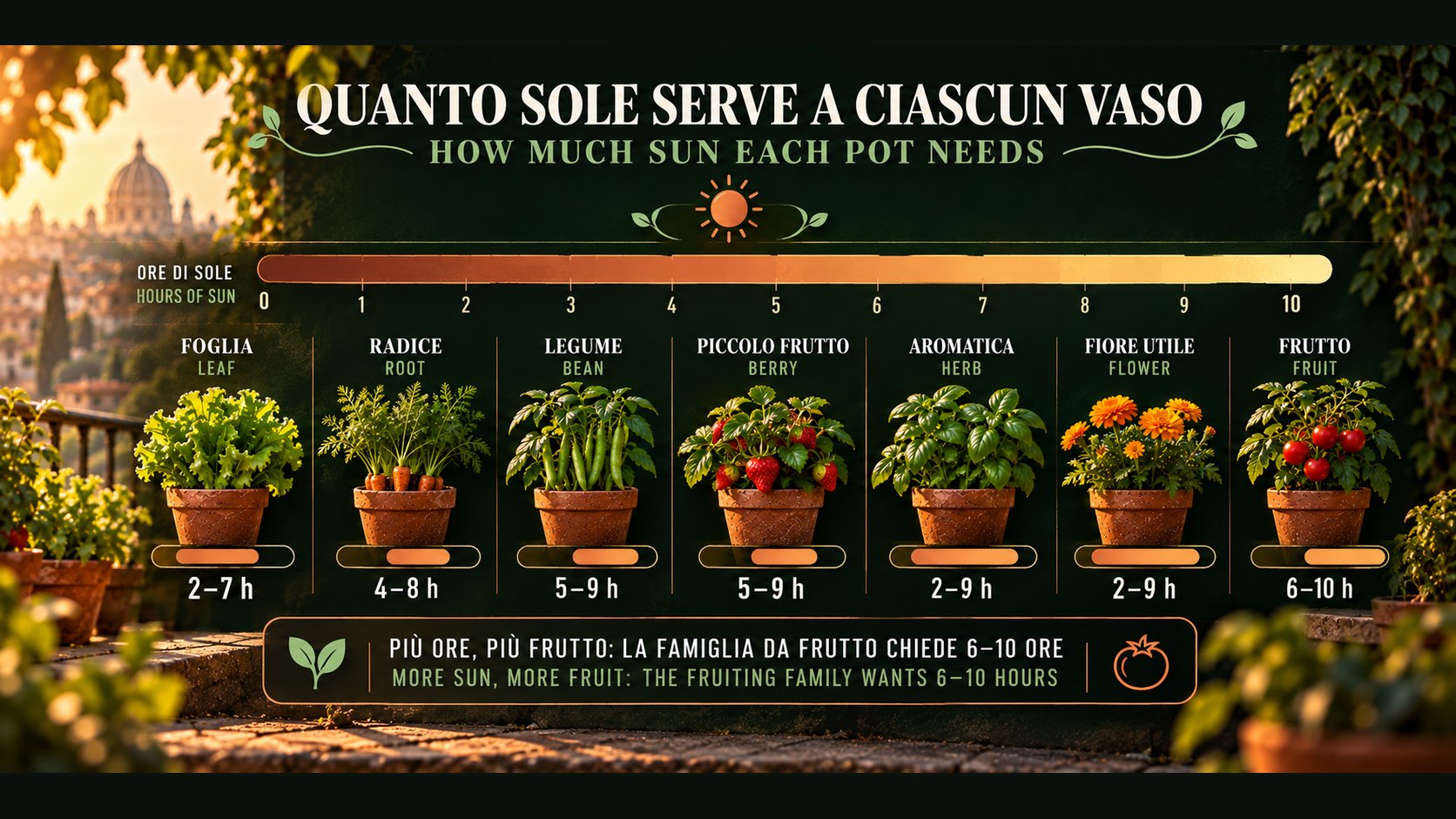

Before choosing a plant, measure the light on the balcony. Hours of direct sun per day are not the hours when the sun is up: only those in which your balcony receives direct light, without shade, count. From the 120-profile dataset, here’s the real need per family.
Light on the balcony: direct sun hours per family
| Family | Direct sun | What it means |
|---|---|---|
| Fruiting vegetable | 6–10 h | Full sun is essential for fruit and flavour |
| Leaf vegetable | 2–7 h | They do well in partial shade |
| Root or bulb | 4–8 h | Half a day of direct sun |
| Compact legume | 5–9 h | Full or near-full sun |
| Herb | 2–9 h | The most flexible of all |
| Soft fruit | 5–9 h | Needs full sun to fruit |
| Beneficial flower | 2–9 h | From partial shade to full sun |

How to measure
This is how you measure light on the balcony: for a day or two, note when the sun comes onto your balcony and when it disappears behind the shadows of nearby buildings. Subtract: the result is your direct sun hours. Compare with the table. If your balcony has 4–5 hours of direct sun, aim for leafy vegetables, roots and herbs; if it has 7–8 or more, you can try the fruiting vegetables.
Exposure matters as much as hours
A south-facing balcony gets more sun and heat; a north-facing one less. Exposure also changes the wind and the risk of late frosts. The Exposure evaluator tool helps you combine sun hours and orientation, the two halves of light on the balcony.
Sources
- Royal Botanic Gardens, Kew — Plants of the World Online — taxonomy
- Royal Horticultural Society — plant care
- University of Maryland Extension — container growing
- University of Minnesota Extension — container + climate
- Penn State Extension — urban container growing