
The pot is the first decision of the balcony garden, and it is the one made worst: you buy the pretty one, then the plant grows two leaves and dies of thirst. It is not the plant’s fault: with pots for vegetables, it is the container’s fault.
Below you will find the volume rule (how many litres each vegetable needs), the choice of material, drainage — and the 5 pots I really recommend, with the links to buy them.
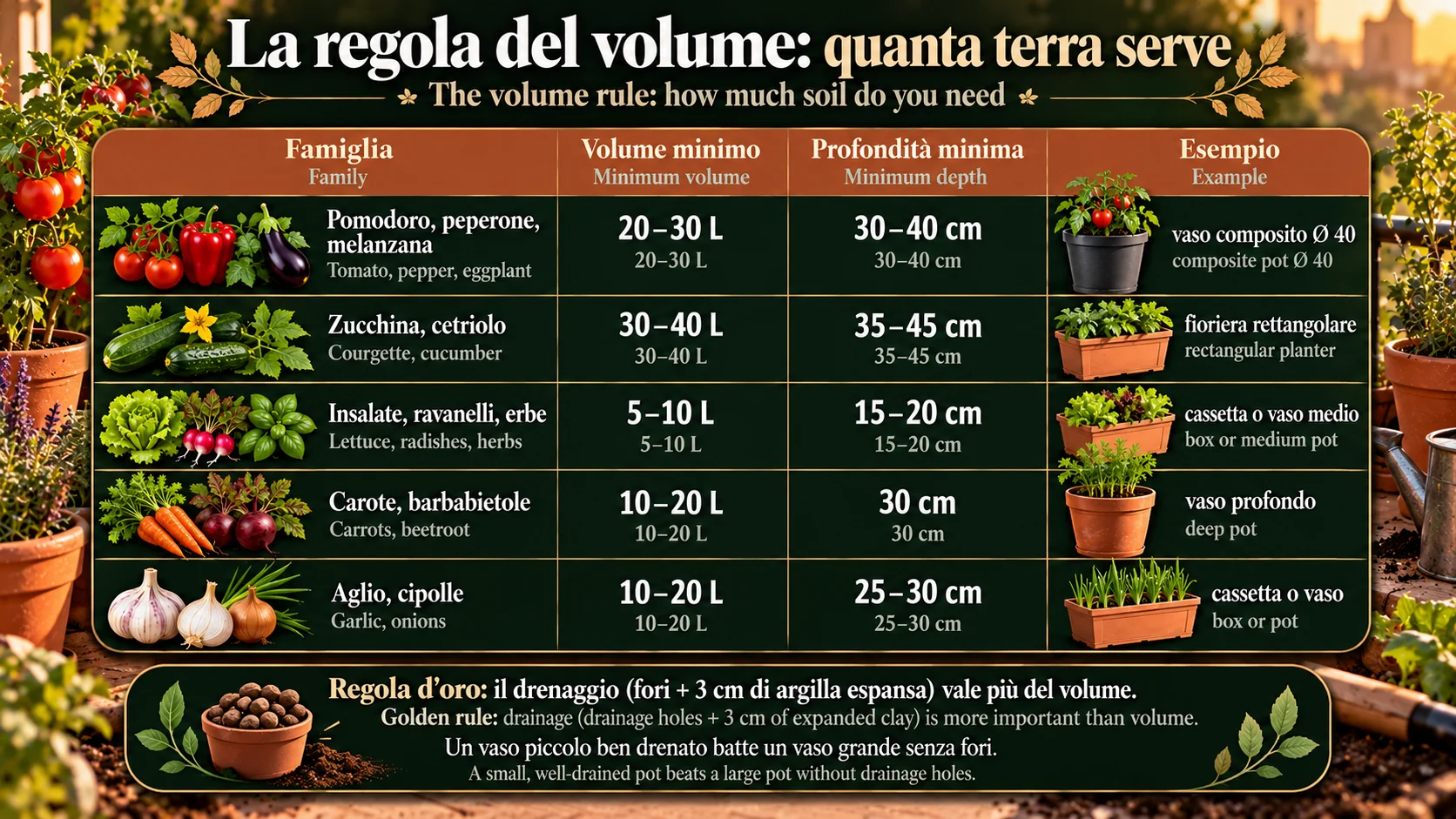
The volume rule: how much soil do you need?
The golden rule: the volume of the pot must exceed the final volume of the root system. Not the diameter that “looks nice” — the litres.
| Family | Minimum volume | Minimum depth |
|---|---|---|
| Tomato, pepper, aubergine | 20–30 L | 30–40 cm |
| Courgette, cucumber | 30–40 L | 35–45 cm |
| Salads, radishes, herbs | 5–10 L | 15–20 cm |
| Carrots, beetroot | 10–20 L | 30 cm |
| Garlic, onions | 10–20 L | 25–30 cm |
Two honest notes:
- Below the minimum volume you can still grow, but the harvest is reduced and the care doubles (watering every day in summer). It is not failure, it is a compromise.
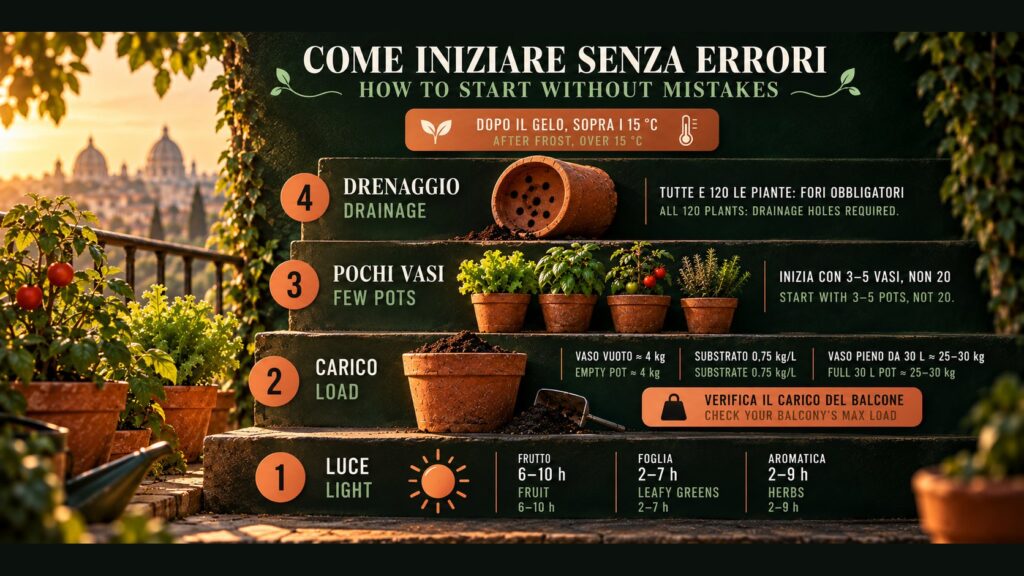
- Beyond 40 litres the pots weigh 40+ kg full: on a rented balcony, check the structure of the railing and how you will move them to clean it.
Material: terracotta, plastic, composite — for pots for vegetables
- Terracotta: it breathes, it dries the edges of the substrate, it is the traditional choice for herbs and tomato. Against: heavy, it breaks, it costs more, on a windy balcony in summer it dries out in an afternoon.
- Plastic/PE (composite): it holds moisture longer, it is light, it costs little, it does not break. Against: in full summer sun the substrate heats up more (light-coloured pots help).
- Fibre/carbon: light and pretty, but more expensive and it ages in the sun.
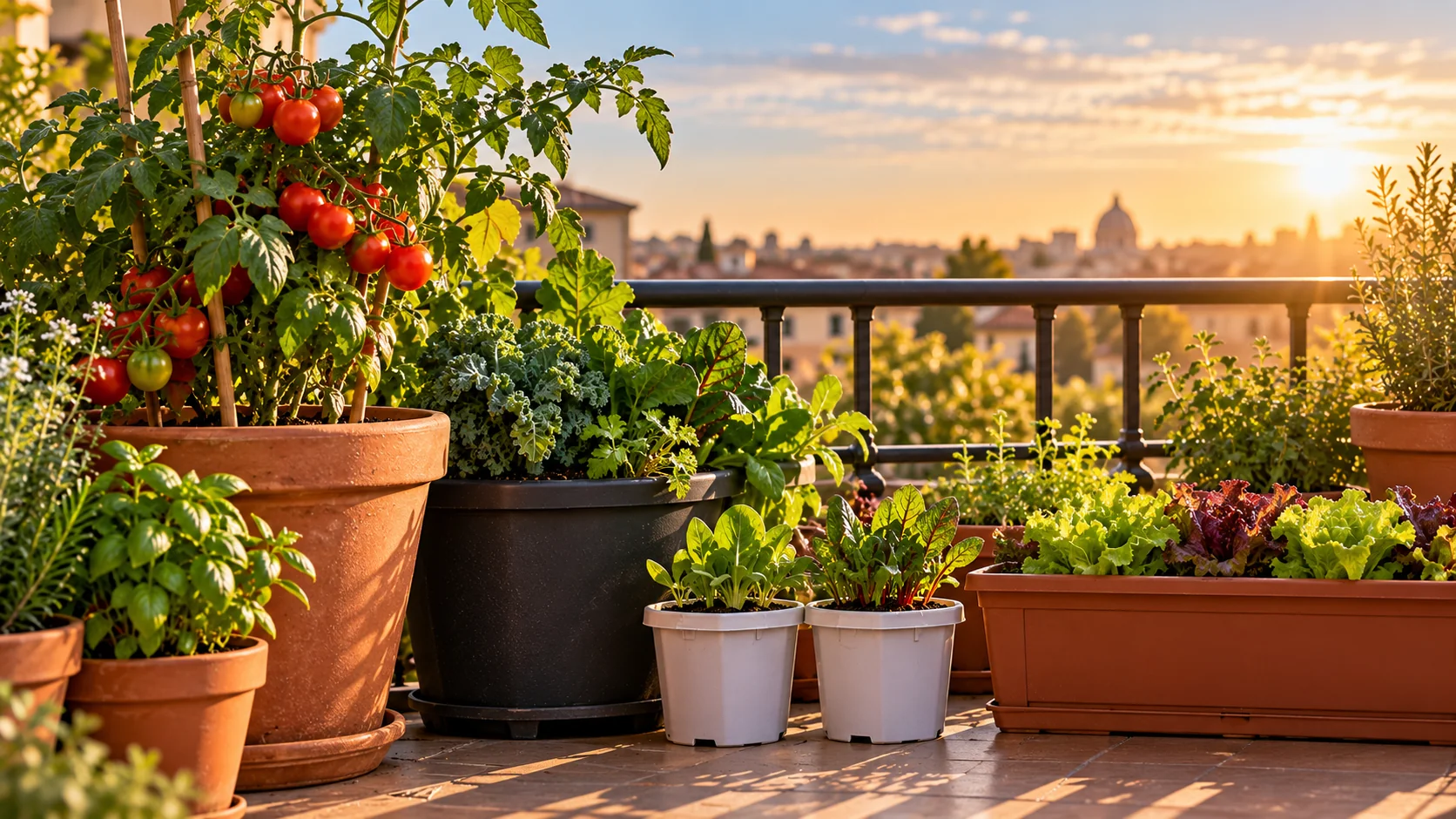
For pots for vegetables in the centre–north, my preference: dark composite or PE for the big volumes (tomato, courgettes), terracotta for salads and herbs where the “breath” helps. The beauty of plastic is that a 30 L pot goes down to the cellar and back up in a minute.
Shape and depth: the two criteria for pots for vegetables
- Tall cylinder: the best for taproots (carrot, beetroot, garlic)
- Classic round: fine for almost everything, it is the standard
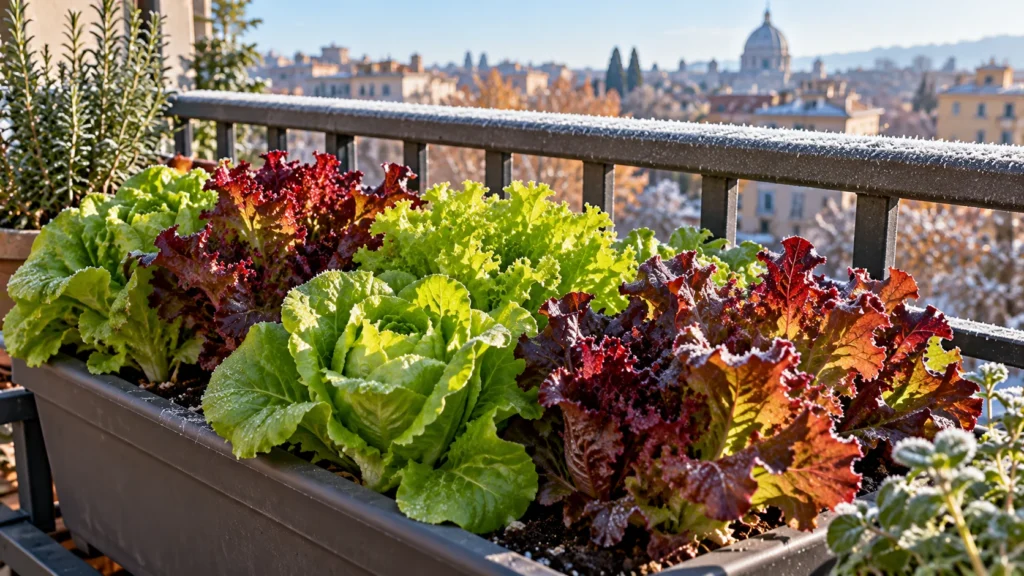
- Rectangular tray: perfect for salads, radishes, herbs, small onions (short-cycle, shallow plants). With a 50×20 cm tray you grow 8–12 salads
- Avoid: deep, narrow pots like the “ficus pots” (roots making a ball) and very wide, low pots for deep vegetables
Drainage: the most common beginner mistake with pots for vegetables
No drainage = no vegetable potting. Period.
The elements that really matter:
- Holes in the bottom (and in the low sides, if the pot allows): at least 5–6 holes of 8–10 mm
- A thin layer of expanded clay over the holes (optional): it only stops the compost from clogging the holes without blocking the water. A 2-litre bag lasts months: Albagarden expanded clay is the one I use
- Never a saucer full of water: stagnant water under the pot keeps the roots in damp even when it is not raining. Empty it after every watering
The right compost (and the reasons) is in the Substrate and drainage guide.
The 5 pots for vegetables I recommend
I chose them to cover the 5 real use cases of the balcony garden. They are all pots with drainage holes and a saucer, all used in urban gardens and not just as ornamental pots.
1. The hard workhorse: 30 L tub
30-litre tub, Ø40 cm in polyethylene, terracotta colour, with handles.
- For whom: tomato, pepper, aubergine, courgette
- Why: 30 L real (not “25 and a half”), real handles to move it full, a material that does not break. It is the pot you put out every year and never think about again
- Price: budget range compared to an equivalent composite
2. If you are away the weekend: self-watering pot
Bama self-watering pot 30×30×22 cm with water tank and indicator.
- For whom: whoever leaves on Saturday night and comes back on Monday, or whoever forgets to water
- Why: the tank stores 2–4 days of autonomy; the wick brings water where it is needed without waterlogging
- Honest note: it is not magic — in the full sun of July it still needs a check, and the 22 cm of depth makes it more suitable for salads, herbs and cherry tomato than for a tomato with 30 cm of roots
3. The tray for salads and herbs
Veca Roxanne tray 50×20×18 cm, about 10–12 litres, terracotta colour, UV and frost-resistant resin.
- For whom: salads, radishes, parsley, basil
- Why: a pocket shape for 8–12 short-cycle plants, light, made in Italy, and it survives outdoor winters without cracking
- Pairing: two trays in a row = a “salad planter” that covers the weekly consumption
4. Faux terracotta: the plastic pot that never cracks
If you want the terracotta look, take a 20 L terracotta-coloured plastic pot with saucer: the right volume for a tomato or three peppers, without the 25 kg of a 40 cm piece. This 20-litre Ø40 in terracotta-coloured plastic with saucer is plastic, not real clay: lighter and immune to frost cracks. Either way, check that it has holes in the bottom and at least 25–30 cm of internal depth.
- For whom: whoever wants the traditional look without the weight or the frost-crack risk (but without the breath of real clay, which plastic does not have)
- Attention: on an exposed balcony, summer evaporation is fast: check the substrate every day, black plastic pots heat up.
n
n
5. The pot without a pot: the 20 L fabric pot (pack of 5)
Non-woven fabric is a pot in every sense: it drains and air-prunes the roots through the walls, it weighs almost nothing, it costs little, and it folds away at the end of the season. The Praknu pack of five 20 L bags with handles and plant labels is what I use for garlic, potatoes and experiments. One honest drawback: water evaporates through the walls faster than from rigid pots, so in midsummer you need one or two extra waterings a day.
e free holes and watering without waterlogging.
How to buy pots for vegetables (and not throw money away)
- Always check the holes (especially in “decorative” pots and cheap resin ones: sometimes they do not have them)
- Measure the internal depth, not the external height: the saucer and the rim subtract 3–5 cm
- Big pots cost little: a 30 L PE costs less than two “pretty” 10 L potlets. Buy big and put the pretty potlets on top, for the herbs
- In winter empty pots go to the cellar: do not leave them out in full frost, they crack (especially terracotta)
Frequently asked questions
Can I use the supermarket plastic trays as pots?
Yes, if you drill the holes (8–10 mm drill, 5–6 holes). They work very well, but thin plastic degrades in the sun in 2–3 seasons.
How many vegetables fit in a 30-litre pot?
It depends: 1 tomato (with a stake), 2–3 peppers, 2 aubergines, or 6–8 salads in succession.
Are pots with side holes better?
Low side holes help drain excess water in tall pots. They are a plus, not a necessity: well-sized holes in the bottom are enough.
Related plant cards
Pot size, litres and sun hours for each plant are in the individual cards: Tomato, Lettuce, Carrot, Strawberry, Rosemary.
Recommended products in this article
Sources
- Product technical specifications: Amazon sheets of the individual articles (volumes, materials, dimensions)
- Orto da Coltivare — Growing in pots: recommended volumes and depths by family
- CREA — urban agriculture and container gardens: guidelines on substrates and drainage
As an Amazon Associate I earn from qualifying purchases. Note: some links on this site are affiliate links: if you purchase through them, I may receive a commission at no extra cost to you. Affiliate links never influence my recommendations.