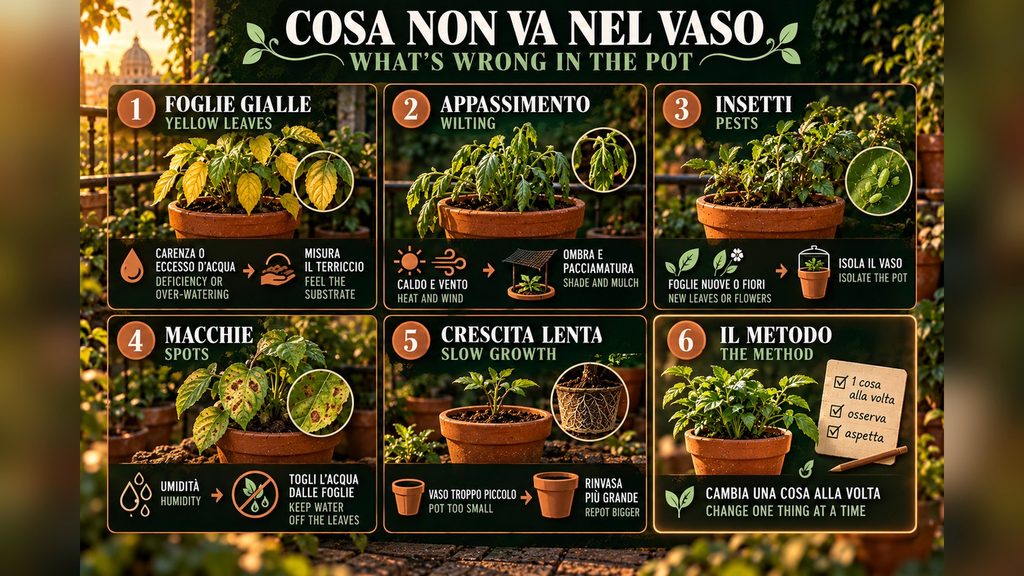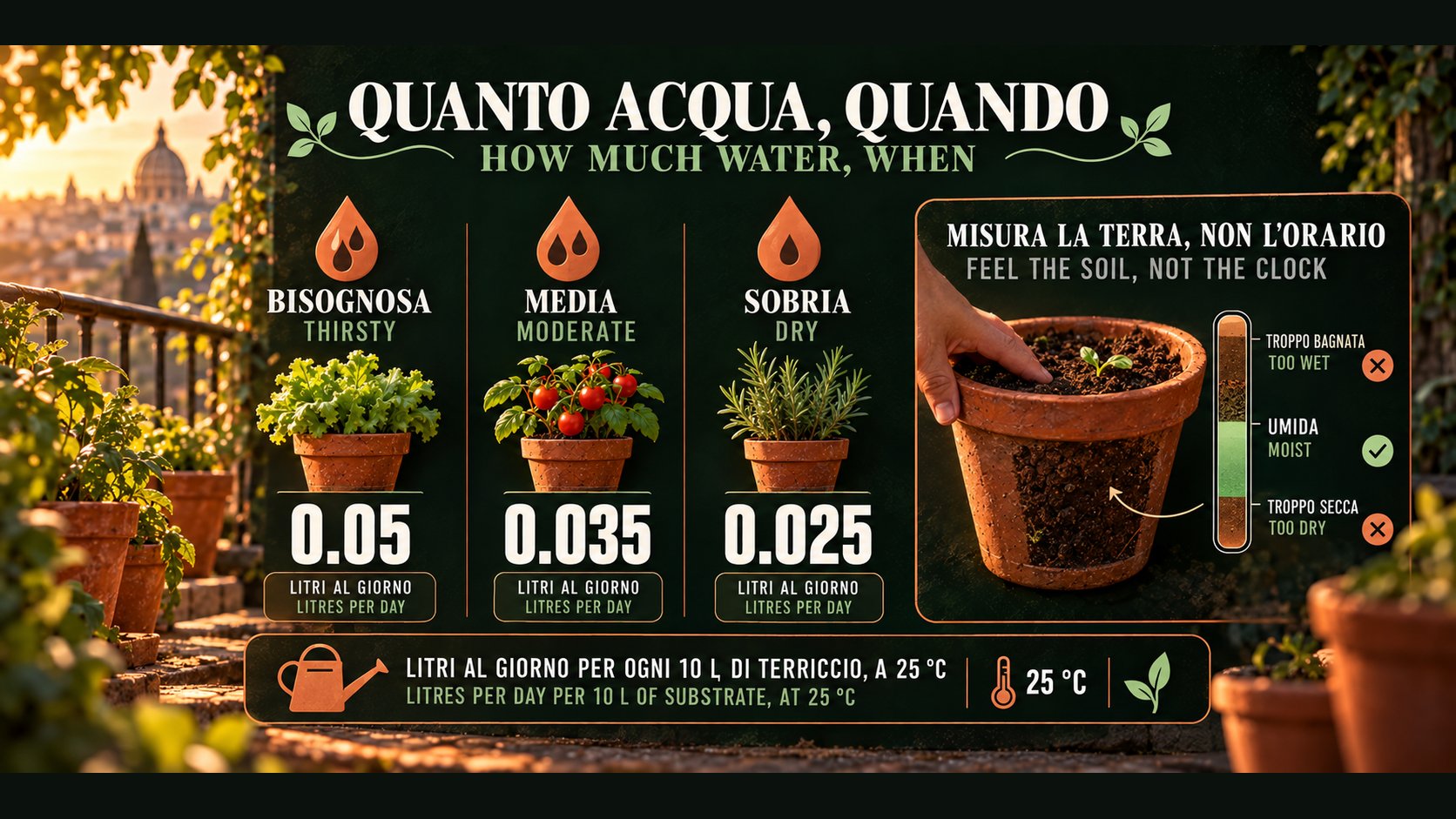

Watering in containers has its own logic. In a pot the soil dries out much sooner than in the ground: the substrate is exposed to sun and wind and has no buffer from the surrounding soil. The golden rule is not a fixed time but the measure of the substrate: push a finger in 2–3 cm: if it’s dry, it’s time to water.
Watering in containers: the real factors
The site’s tools use three demand regimes for watering in containers, expressed in litres per day per 10 L of substrate, at 25 °C:
| Regime | Factor | Who |
|---|---|---|
| High | 0.05 L | Tomato, cucumber, courgette, frequently-cut lettuce |
| Medium | 0.035 L | Many vegetables and herbs |
| Low | 0.025 L | Rosemary, sage, lavender |

What changes it
- Temperature and wind raise the demand: in hot weather and on an exposed balcony, check daily.
- The pot material matters: terracotta dries out faster than plastic.
- Drain, don’t drown. Water should run out of the holes; waterlogging rots the roots.
Use the Watering estimate tool: enter plant, temperature and exposure and you get a reference in litres per day. It is a reference, not a fixed time: the substrate measure stays the final check in watering in containers.
Sources
- Royal Botanic Gardens, Kew — Plants of the World Online — taxonomy
- Royal Horticultural Society — plant care
- University of Maryland Extension — container growing
- University of Minnesota Extension — container + climate
- Penn State Extension — urban container growing