
October is the month when the balcony garden changes its skin: the summer vegetables are over, the sun drops, and whoever sows now beats whoever waits for spring. Not because winter is an obstacle — it is an advantage — but because plants sown in October put down solid roots before the cold, and unlike the March seedlings they never suffer the summer heat and produce more.
This guide tells you exactly what to sow in October on the balcony, by family, with the right dates and the traps to avoid.
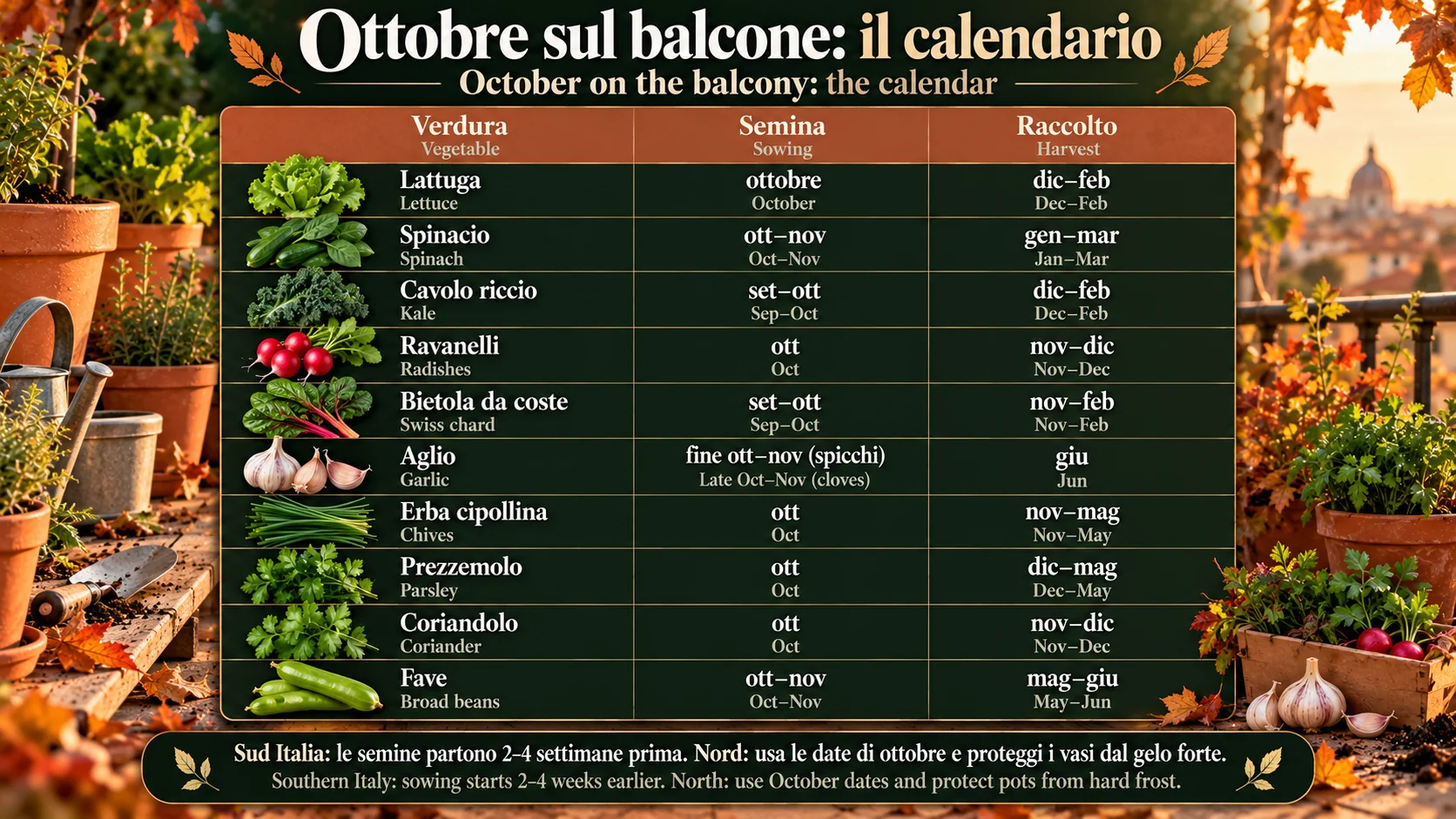
October’s calendar in one table
The overview before the details. Dates for central and northern Italy; in the South, start 2–4 weeks earlier.
| Vegetable | Sow | Transplant | Harvest |
|---|---|---|---|
| Lettuce | October | — | Dec–Feb |
| Spinach | Oct–Nov | — | Jan–Mar |
| Curly kale | Sep–Oct | Nov | Dec–Feb |
| Radishes | October | — | Nov–Dec |
| Swiss chard | Sep–Oct | Nov | Nov–Feb |
| Garlic | late Oct–Nov (cloves) | — | June |
| Chives | October | — | Nov–May |
| Parsley | October | — | Dec–May |
| Coriander | October | Nov | Nov–Dec |
| Broad beans | Oct–Nov | — | May–Jun |
Leafy vegetables: lettuce, spinach, kale
They are the queens of autumn in pots, and the reason is simple: cold makes them sweeter. Below 10 °C the plants convert sugars into starch and the tissue firms up: winter lettuce tastes better than summer lettuce, and spinach holds on at −5 °C without suffering.
- Lettuce: sow on the surface or at 1 cm, 15 cm apart. In October it grows slowly but steadily; from November we protect it with a canopy or a net (the Protection from weather guide explains how). Full profile: Lettuce.
- Spinach: sow at 1–2 cm, 10 cm apart. It germinates even in 3–4 weeks of short days. Profile: New Zealand spinach.
- Curly kale: transplant seedlings 30 cm apart in a deep pot (20 L or more). It is the most frost-resistant vegetable you can have on the balcony. Profile: Curly kale.
Garlic and small onions: the sowing that pays off
If you could only make one sowing in October, this would be it. Garlic planted in late October–November overwinters in the pot, and in June gives you mature heads without you having thought about it (the only care: water in spring, no fertiliser).
Planting is trivial: one clove per hole, pointed end down, 3–4 cm deep, substrate on top. Ten cloves in a 20 L pot. The complete step-by-step guide is here: Garlic in pots: how and when to plant. The plant profile: Garlic.
Small onions behave the same way: sow in October in the South; in central–northern autumn, plant the seedlings in November.
Herbs that shrug off the cold
Three herbs are sown or divided in October and give you leaves all winter:
- Chives — sow at 5 mm depth, or divide existing clumps. It survives frosts, and the March flowers are edible. Profile.
- Parsley — sow in October; germination is slow (3–4 weeks): if you see nothing for two weeks, do not re-sow, it is normal. Profile.
- Coriander — sow at 5 mm, germinates in 2 weeks. Light cold delays bolting, so you harvest the flowers and seeds (the cumin) in March–April. Profile.
Legumes: broad beans and late peas
- Broad beans: in October in the South, from late October to November in the North. Dwarf varieties (like the Dwarf broad bean) do well in deep pots. Sow at 3–4 cm, 10 cm apart.
- Peas: here the honest rule: in northern Italy you do not sow in October. Dwarf peas are sown from February. In the South, winter varieties start up to late October with light protection.
Indoor sowing: tomato, pepper, aubergine (for spring)
Here is the trick few know: in October you sow indoors, not on the balcony. Tomato, pepper and aubergine have a long cycle (6–8 months from seed to fruit), and whoever sows them in October–November in pots on a sunny windowsill already has big plants when others buy seedlings in March.
- Tomato and pepper: sow in 8 cm pots, seed-raising compost, 20–25 °C. Indoors in winter it is 15–18 °C: add a light or a seedling heat mat, adjustable up to 35 °C. The Best grow lights guide arrives in mid-December.
- Aubergine: same thing, but it wants 25 °C to germinate: the mat is not optional.
- Transplant to the big pot: in February–March, when the plants have 4–5 true leaves.
It is not for everyone: it takes patience and light. But in June you have plants nobody else sees, and the savings on seedlings are real.
What NOT to sow in October (and why)
Summer vegetables are out: tomato, pepper, aubergine, courgette, cucumber, basil. They are frost-tender, they need a stable 20 °C to germinate and grow; in October, in a pot, they produce stress and disease. The classic mistake is “trying anyway” — the result is weak seedlings that do not survive the winter.
Carrots and beetroot are a no too: spring sowing (March–April); in October the seed germinates but the root does not develop well.
The table in the Sowing and transplanting guide has the complete calendar for every month.
Getting ready for November
While the October sowings settle, prepare the ground for November:
- Empty pots: clean and sterilise them (vinegar or a boil), then fill them with fresh substrate.
- Pots in use: remove the remains of diseased summer plants (never compost the sick).
- Water: watering drops, but the substrate must not dry out — winter roots die more of thirst than of cold.
- Protection: a balcony canopy or a mini greenhouse cost little and save the salads in hard frosts (Protection from weather).
- To buy: a large pot (20–30 L) for the garlic, a garden seed kit with 12 varieties (lettuce, radish and beetroot are sown right in this period) and fresh substrate.
Next month (12/11) we publish the November calendar — same format, same dates.
Frequently asked questions
Do salads sown in October survive the frost?
Yes, leaves hold on down to −3/−4 °C; below that you need protection (canopy, net, mini greenhouse). Light cold improves them: more sugars, less bitterness.
Can I sow tomato in October on the balcony, outdoors?
No. Below 15 °C the seed does not germinate and the seedlings die. In October the tomato is sown indoors only (see the section above).
How much water do autumn sowings want?
Less than in summer: the substrate must stay moist, never waterlogged. A finger check once a day, at 2 cm depth, is enough; if it is dry, warm water and a little of it.
Sources
- October sowing calendar, Orto da Coltivare: https://www.ortodacoltivare.it/calendario/calendario-delle-semine/semine-ottobre/
- What to plant in October in the garden and on the balcony: calendars by climate zone, Ortofacile: https://www.ortofacile.com/cosa-piantare-a-ottobre.html
- CREA (Council for Agricultural Research and Economics): guidelines on container vegetable growing and the agronomic calendar.